ChocoPoC: Fake Exploits on GitHub Are Hunting Security Researchers
A malware campaign flips the script on bug hunters: fake proof-of-concept exploits on GitHub secretly install the ChocoPoC remote access trojan.
A malware campaign is turning the tables on the people who hunt software flaws for a living. Researchers at YesWeHack and Sekoia say attackers are publishing fake proof-of-concept (PoC) exploits for recent vulnerabilities on GitHub. When a security researcher runs one, it quietly installs a remote access trojan called ChocoPoC, which steals passwords, files and browser data and then hands the operators full control of the machine.
Hidden in the dependency chain, not the exploit
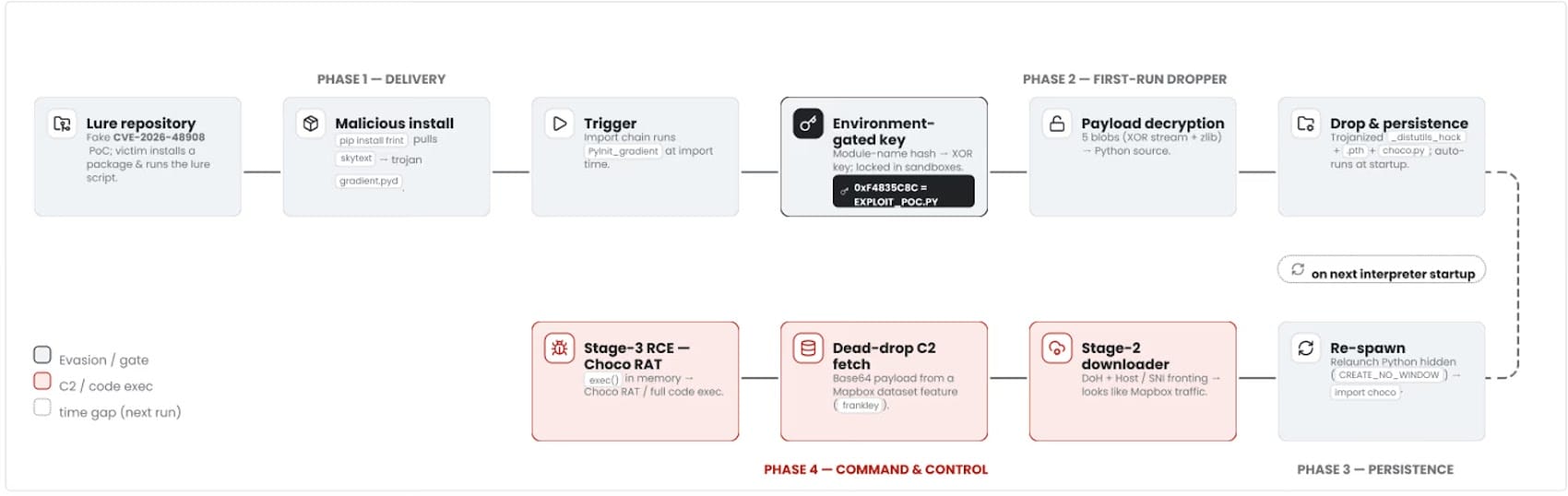
The clever part is where the malicious code is not. According to the researchers, nothing suspicious lives in the exploit files themselves, so a quick read of the repository turns up clean. The trap springs only when the victim runs pip install: the PoC pulls in a dependency called frint, which in turn downloads a package named skytext. Inside it sits a compiled module, gradient.so on Linux or gradient.pyd on Windows.
That module activates only when it runs alongside the PoC, and only if it finds a file named EXPLOIT_POC.py or something close to it. Only then does it unpack the payload and load ChocoPoC. Because of this environment gating, running the malicious package on its own in a sandbox does nothing at all: without the rest of the repository, the malware stays dormant.
What ChocoPoC steals
Once active, ChocoPoC behaves like a full remote access trojan. It pulls saved passwords, cookies, autofill data and history from Chrome, Brave, Edge and Firefox. It also collects text files, notes, local databases, command-line history, network settings and the list of running processes. On top of that, the operators can run arbitrary commands and Python code, download entire directories, and pause the malware to avoid drawing attention.
Some of the command names are written in Spanish, and the code contains small mistakes. To the researchers, that suggests it was written by hand rather than generated with AI.
Command and control hidden in Mapbox traffic
For control, ChocoPoC uses a dataset on the mapping service Mapbox, where the addresses of its infrastructure are hidden. The malware fetches its command server address over DNS-over-HTTPS and uses domain fronting, so the traffic looks like ordinary calls to the Mapbox API.
Seven fake repositories, real CVEs
The researchers found at least seven fake repositories, each claiming to hold an exploit for a real, recent vulnerability:
- FortiWeb (CVE-2025-64446)
- React2Shell (CVE-2025-55182)
- MongoBleed (CVE-2025-14847)
- PAN-OS (CVE-2026-0257)
- Ivanti Sentry (CVE-2026-10520)
- Check Point VPN (CVE-2026-50751)
- Joomla SP Page Builder (CVE-2026-48908)
The skytext package used in the attacks was downloaded around 2,400 times, mostly by Linux users. Downloads alone do not reveal how many machines were infected, but the researchers note that the peaks lined up with the disclosure of serious vulnerabilities.
Not the first wave
The campaign appears to date back to late 2025, when the attackers used almost identical packages named slogsec and logcrypt.cryptography. The same operators are very likely behind both waves, since the code carried repeating markers tied to the command infrastructure. Throughout, they kept rotating their GitHub, PyPI and Mapbox accounts, and some of those accounts may have been hijacked or created with stolen credentials.
How to protect yourself
Sekoia's takeaway is blunt: treat every PoC exploit as potentially dangerous, inspect the entire dependency chain, and avoid packages published by unknown or newly created accounts. Because even running an exploit inside a virtual machine does not guarantee that ChocoPoC will reveal itself, the safest move is not to install suspicious dependencies at all.
The researchers also recommend checking systems for frint, skytext, slogsec and logcrypt.cryptography. If any of them has run, they advise rotating your credentials and fully reinstalling the system.
Based on research by YesWeHack and Sekoia.
Written by

Read next
Ill Bloom: A Weak Seed-Phrase Generator Drained Over $5M From Crypto Wallets
Researchers at Coinspect have disclosed Ill Bloom, a vulnerability in how several cryptocurrency wallets generate their mnemonic recovery phrases (seed phrases). Exploiting it, attackers emptied hundreds of wallets in a single pass and made off with more than $5.1 million. The problem is not one specific wallet but the phrase-generation method used by a handful of lesser known apps, mobile and browser extensions, some dating back to 2018. These wallets relied on a weak random number generator,
The $3 Billion Click: How a Programmer Robbed the Darknet and Lost It All to the State
The James Zhong case shows that blockchain anonymity is an illusion, and that bugs in code have no statute of limitations.
$643M in Six Months: How Lazarus Operates and Where the Evidence Runs Out
In the first half of 2026, analysts at TRM Labs attributed roughly $643 million to groups linked to North Korea, about 66% of everything stolen from the cryptocurrency industry, out of some $972 million lost across 207 incidents. Almost all of it came from two April attacks on DeFi protocols: the roughly $292 million breach of KelpDAO and the $285 million hit on Drift Protocol. A year earlier the shape was similar but the scale was not. Chainalysis put 2024 losses to DPRK-linked hackers at $1.34
Microsoft Patches a Record 570 Flaws, Two Zero-Days Already Under Attack
On Tuesday, July 14, Microsoft shipped the largest set of fixes in Patch Tuesday history, closing 570 vulnerabilities at once. Attackers are already exploiting two of them in the wild, and a third was publicly disclosed before the patch landed. The most serious of the exploited bugs is CVE-2026-56164 in Microsoft SharePoint Server. A missing authentication check in a critical function lets an unauthenticated attacker escalate privileges across the network, with no password at all. Researchers a
LegacyHive: Unpatched Windows Zero-Day PoC Dropped Hours After Patch Tuesday
Within hours of July's Patch Tuesday, a researcher going by Nightmare Eclipse (also seen as Chaotic Eclipse) published a proof-of-concept exploit for a new Windows vulnerability dubbed LegacyHive. No patch existed at the time of release, and the exploit works on the latest build of the system, assembled with July's updates already applied. The vulnerability lives in the Windows User Profile Service (ProfSvc) and its registry hive loading mechanism. When a user signs in, Windows mounts the UsrCl