Crypto Theft Fell to $972M in H1 2026, but North Korea's Share Climbed to Two-Thirds

In the first half of 2026, attackers stole about $972 million from the cryptocurrency industry across 207 incidents, according to a mid-year report from analytics firm TRM Labs. The figure is down by more than half from the same period in 2025, when losses were put at $2.3 billion.
Despite the overall decline, the share tied to North Korea has actually grown. Analysts attribute roughly $643 million, about 66% of the half-year total, to the Lazarus Group and its TraderTraitor subunit. Almost all of that came from two April attacks on DeFi protocols: the roughly $292 million KelpDAO breach and the $285 million hit on Drift Protocol. By available accounts, the first was a supply chain attack and the second turned on social engineering.
North Korea's share is nonetheless lower than a year earlier, when about $1.7 billion in H1 2025 was attributed to the DPRK. Even so, by cumulative volume Pyongyang remains the single largest source of crypto theft in the world, with linked groups having drained an estimated $6 billion since 2017.
The drop in the overall total owes less to stronger defenses than to the absence in the first half of a mega-heist on the scale of last year's Bybit breach. The number of incidents itself remains high, and the leading causes of loss are still private key compromise, social engineering, and smart contract vulnerabilities.
Based on reporting by TRM Labs.
Written by

Read next
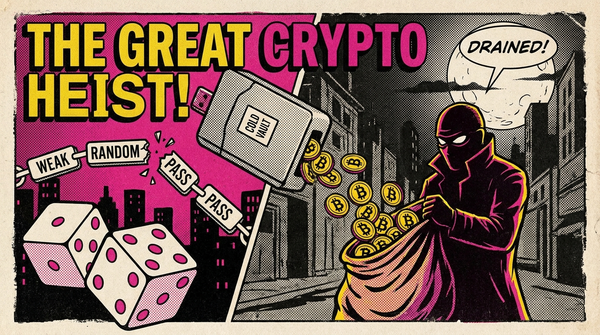
Ill Bloom: A Weak Seed-Phrase Generator Drained Over $5M From Crypto Wallets
Researchers at Coinspect have disclosed Ill Bloom, a vulnerability in how several cryptocurrency wallets generate their mnemonic recovery phrases (seed phrases). Exploiting it, attackers emptied hundreds of wallets in a single pass and made off with more than $5.1 million. The problem is not one specific wallet but the phrase-generation method used by a handful of lesser known apps, mobile and browser extensions, some dating back to 2018. These wallets relied on a weak random number generator,Microsoft Patches a Record 570 Flaws, Two Zero-Days Already Under Attack
On Tuesday, July 14, Microsoft shipped the largest set of fixes in Patch Tuesday history, closing 570 vulnerabilities at once. Attackers are already exploiting two of them in the wild, and a third was publicly disclosed before the patch landed. The most serious of the exploited bugs is CVE-2026-56164 in Microsoft SharePoint Server. A missing authentication check in a critical function lets an unauthenticated attacker escalate privileges across the network, with no password at all. Researchers a
The EU and UK Hit Russia With Their First Joint Cyber Sanctions
The sanctions target FSB Centre 16, the arm of Russian intelligence behind one of the world's most durable hacking operations, over a decade of attacks on Europe including an attempt to black out Poland in winter.
Fake FSB Officer Tried to Shake Down the Conti Ransomware Gang
A Moscow man allegedly posed as an FSB officer and demanded money from one of the most dangerous ransomware crews in history. He is now in jail.
$643M in Six Months: How Lazarus Operates and Where the Evidence Runs Out
In the first half of 2026, analysts at TRM Labs attributed roughly $643 million to groups linked to North Korea, about 66% of everything stolen from the cryptocurrency industry, out of some $972 million lost across 207 incidents. Almost all of it came from two April attacks on DeFi protocols: the roughly $292 million breach of KelpDAO and the $285 million hit on Drift Protocol. A year earlier the shape was similar but the scale was not. Chainalysis put 2024 losses to DPRK-linked hackers at $1.34
Microsoft Patches a Record 570 Flaws, Two Zero-Days Already Under Attack
On Tuesday, July 14, Microsoft shipped the largest set of fixes in Patch Tuesday history, closing 570 vulnerabilities at once. Attackers are already exploiting two of them in the wild, and a third was publicly disclosed before the patch landed. The most serious of the exploited bugs is CVE-2026-56164 in Microsoft SharePoint Server. A missing authentication check in a critical function lets an unauthenticated attacker escalate privileges across the network, with no password at all. Researchers a
LegacyHive: Unpatched Windows Zero-Day PoC Dropped Hours After Patch Tuesday
Within hours of July's Patch Tuesday, a researcher going by Nightmare Eclipse (also seen as Chaotic Eclipse) published a proof-of-concept exploit for a new Windows vulnerability dubbed LegacyHive. No patch existed at the time of release, and the exploit works on the latest build of the system, assembled with July's updates already applied. The vulnerability lives in the Windows User Profile Service (ProfSvc) and its registry hive loading mechanism. When a user signs in, Windows mounts the UsrCl